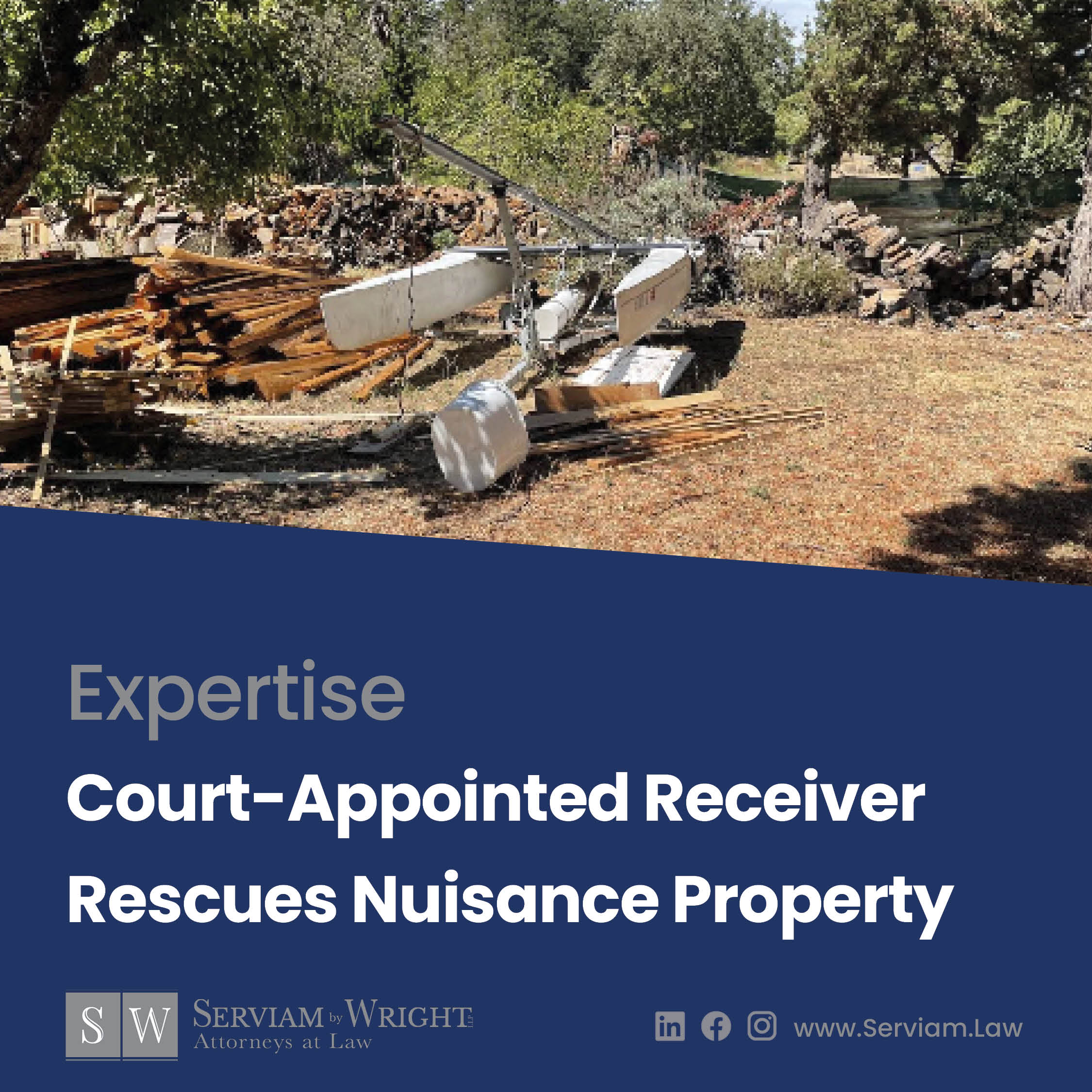
When a privately owned wastewater treatment plant serving a California mountain community fell into crisis—insolvent, inoperable, and out of regulatory compliance—a California Superior Court turned to Serviam by Wright LLP to serve as Court Receiver. What followed was a structured, court-supervised process that stabilized the facility, secured public funding, and ultimately transferred the system to a governmental entity capable of operating it in full compliance with California law and regional water board permitting requirements. The case stands as a practical example of what effective court receivership can accomplish for communities and public agencies facing intractable utility or infrastructure failures.
A Public Utility System in Crisis
The wastewater treatment plant ("WWTP") had experienced years of decline before the Court's intervention. A major wildfire devastated the surrounding community, destroyed critical infrastructure at the WWTP, and left the facility without power and inoperable for an extended period. By the time the Court appointed a receiver, the WWTP had no corporate operating funds and was described as insolvent without public support. There was no viable path to self-sustaining regulatory compliance under private ownership.
Receivership: Stabilization and Operations
Upon appointment, Serviam assumed possession and control of the WWTP and engaged a professional water services operator to manage the facility on a day-to-day basis. Serviam, as the Court Receiver secured funding from the regional water board to cover operating costs, repairs, and necessary infrastructure upgrades. This emergency stabilization phase was essential to halt further regulatory deterioration and create the conditions for a permanent solution.

"When a utility fails, it is rarely just an infrastructure problem—it is a community in crisis. Public agencies are often left holding responsibility for a situation they did not create and do not have an obvious path to resolve. A court receiver can step in, stabilize the situation, and give everyone—the court, the regulators, and the residents—a structured way forward. Our role as court receiver is not just to manage a legal process—it is to make sure the community on the other side of that process ends up in a better place than where it started." Curtis Wright, Managing Partner at Serviam by Wright LLP
Negotiating a Permanent Transfer
Serviam identified early that a durable resolution required transferring the WWTP to a public entity with the institutional capacity to maintain long-term compliance. The Court Receiver engaged the County, negotiated a transfer of ownership from the private operator to the County, and secured Court approval of the Transfer Agreement. The regional water board supported the process throughout, working in parallel to prepare the permitting approvals necessary for County ownership and operation.
Multi-Agency Coordination and Community Approval
Completing the transfer required coordinating across multiple regulatory bodies and obtaining community consent. The Court Receiver, the County, and the regional water board jointly presented the Consolidation Plan to the affected community at a public meeting. Residents subsequently voted to approve the creation of a new County Service Area zone and the funding structure needed to sustain WWTP operations under County management.
Regulatory approvals followed from the California Public Utilities Commission, which approved the transfer, and from the regional water board, which transferred the operating permit to the County. The breadth of alignment among the Court, the County, the CPUC, and the Regional Water Board reflects the coordination that Serviam managed on behalf of the receivership estate throughout the process.
Discharge and Transfer
With the operational and regulatory transfer complete, the Court Receiver was formally discharged on June 15, 2026—closing the WWTP receivership administration and officially consummating the transfer to the County. From appointment to discharge, the receivership encompassed emergency stabilization, infrastructure rehabilitation, multi-agency negotiations, community outreach, and the full regulatory approval sequence required to transfer a public utility.
What Receivership Means for Public Agencies
This receivership illustrates the core value a court-appointed receiver brings to complex public infrastructure crises. A receiver can assume immediate operational control of a failing system, secure emergency funding, and prevent further regulatory harm—while simultaneously serving as a neutral convener to negotiate solutions among governmental entities, regulators, and private parties. Equally important, a receiver can manage the procedural and regulatory sequencing required to complete a transfer of ownership, navigating court approvals, utility commission proceedings, regional permitting, and local agency formation concurrently.
For counties, cities, and public agencies confronting situations where a privately owned utility or facility poses a risk to public health or regulatory compliance, the receivership mechanism offers a court-supervised path to resolution that is transparent, accountable, and structured to protect all stakeholders.
How Serviam Can Help as Court-Appointed Receiver
Serviam has served as a court-appointed receiver in complex matters involving public utilities, blighted properties, and environmental compliance. Our team understands both the legal framework governing receiverships and the operational realities of managing distressed facilities under court supervision. If your agency is facing a situation that may require a court receiver—or if you need counsel on receivership law, nuisance abatement, or regulatory compliance—we welcome the conversation.