
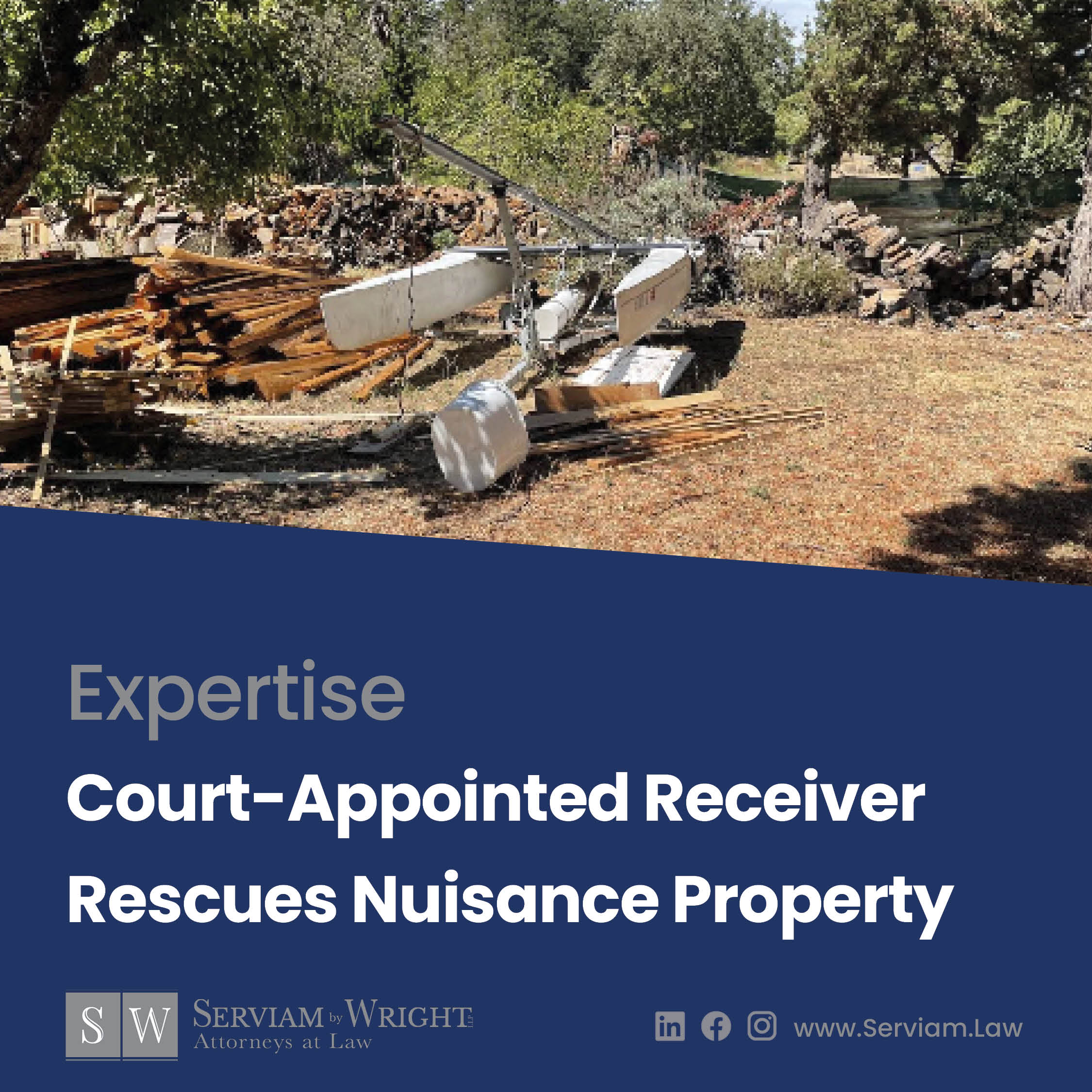
When a property deteriorates past the point where notices and citations can bring it into compliance, California law gives public agencies another path: asking the court to appoint a neutral receiver to take control, correct the violations, and return the property to safe and lawful use. In a recent matter, Serviam was appointed by the Court as Receiver over a severely neglected rural parcel and carried it from public nuisance to a completed sale.
A Rural Parcel in Crisis
The property is an approximately 2.4-acre parcel developed with a single-family A-frame residence, two non-permitted structures with habitable features, and various outbuildings. County inspectors visited the site after neighbors registered complaints and at the request of the Sheriff’s Department.
What they found was extensive. Structures built without permits or approval included two single-family dwellings—both occupied and fitted with habitable features—non-permitted additions to the main residence, and two greenhouses with mechanical and electrical connections that had previously powered cannabis cultivation operations. Hazardous conditions extended across the parcel:
- Water intrusion and non-permitted electrical connections and installations inside the non-permitted structures
- A failing deck presenting a collapse risk
- Inoperable and dismantled vehicles and boats stored throughout the property
- Overflowing trash containers visible in several locations
Taken together, these conditions constituted a public nuisance and posed risks to the occupants, the neighbors, and the emergency responders who might one day be called to the site.
BEFORE PHOTOS


Why Receivership
Under Health and Safety Code sections 17980.6 and 17980.7, when violations are so extensive that they substantially endanger the health and safety of residents or the public, and the owner fails to correct them within a reasonable time after notice, the enforcement agency may ask the court to appoint a receiver. The receiver is an officer of the court—not an agent of the agency or the owner—and acts under the court’s supervision with the powers granted by Health and Safety Code section 17980.7 and Code of Civil Procedure section 568.
For a property like this one, where years of neglect, unpermitted construction, and occupant resistance had outpaced traditional code enforcement tools, a court-supervised receivership offered the most direct route to lasting correction.
Serviam’s Role as Court-Appointed Receiver
Once appointed, Serviam took control of the property and moved on several fronts at once:
- Securing receivership funding. Rehabilitation requires capital the owner had not provided. Serviam secured receivership funding to finance the work under the Court’s supervision.
- Clearing obstruction. Occupants attempted to obstruct the rehabilitation work. Serviam removed them so the court-ordered work could proceed.
- Securing the site. Serviam boarded and secured the property to prevent re-entry and further deterioration.
- Rehabilitating the property. Serviam oversaw the full scope of corrective work from start to finish.
After Photos


From Nuisance PROPERTY to Rehabilitation
The rehabilitation included the turn-key reconstruction of the primary A-frame residence. Every other structure on the receivership property was demolished and removed, and the parcel was cleared of all rubbish, debris, and vehicles. What remained was a single, lawful residence on a clean and safe parcel.
The Result: A Property Returned to Productive Use
With rehabilitation complete, Serviam marketed and sold the receivership property, placing it in the hands of a new owner and closing the chapter on a long-standing source of neighborhood complaints. The outcome reflects what a health and safety receivership is designed to deliver: hazards removed, violations corrected, and a property restored to lawful use under court oversight.
For another example of how receivership can transform a distressed property, see From Hazard to Habitability: A Successful Receivership That Restored a Neighborhood.

“A receivership works when the receiver can act decisively while staying fully accountable to the Court. Here, that meant securing the funding, clearing the obstacles, and rebuilding the home so the property could return to productive use. The neighbors who first raised the alarm now live next to a safe, lawful property.” Mayya Magay, Court Receiver
How Serviam Can Help as a Court-Appointed Receiver
Serviam serves as Court-Appointed Receiver over distressed properties throughout California, including dangerous and dilapidated structures, unpermitted cannabis sites, and properties where occupants resist correction. If your agency is facing a property that traditional enforcement has not resolved, contact Serviam Team to discuss your matter.


